
Pre-Workout Meal: Indian Options and When to Eat
Pre-workout meal ideas with Indian food: what to eat 2–3 hours or 30–60 minutes before the gym, kcal and carbs per portion, chai, coffee and fasted training.
The best pre-workout meal is a normal meal with mostly carbohydrate and some protein, eaten 2–3 hours before you train, or a small carb snack like a banana 30–60 minutes before. Indian options that work well include poha, idli, roti-sabzi, besan chilla, curd with fruit and a piece of chikki. Keep it low in fat and fibre if you're eating close to the session, and count it as part of your day's calories.
When should you eat before a workout?
The sports nutrition guidelines give a window rather than a single time. The 2016 joint position statement of the American College of Sports Medicine, the Academy of Nutrition and Dietetics and Dietitians of Canada suggests 1–4 g of carbohydrate per kg of body weight in the 1–4 hours before exercise lasting more than an hour. The bigger amount fits further out; the smaller amount fits closer in.
The International Society of Sports Nutrition (ISSN) position stand on nutrient timing (2017) also supports carbohydrate-rich meals in the hours before harder, longer sessions.
In practice, for a normal gym day, that becomes two simple options:
| Time before training | What to eat | Rough size |
|---|---|---|
| 2–3 hours | A normal meal: carbs plus some protein, moderate fat | 300–500 kcal |
| 1–2 hours | A light meal: poha, idli, curd and fruit | 150–300 kcal |
| 30–60 minutes | A small carb snack: banana, dates, chikki | 100–200 kcal |
| Under 30 minutes | Little or nothing, or a few sips of juice if you feel low | under 100 kcal |
The kcal sizes are a rule of thumb, not figures from the position stands.
For a hypothetical 65 kg person, 1 g/kg is 65 g of carbs. That's about 2 rotis with sabzi plus a banana. It's the bottom of the official range, and it's aimed at sessions longer than an hour. For a 45–60 minute weights session, a lighter meal is usually enough.
What should a pre-workout meal contain?
Carbohydrate first. It tops up the glycogen your muscles use for hard sets. Roti, rice, poha, idli, fruit and jaggery all work.
Some protein. It doesn't have to be after the workout only. The ISSN timing paper notes that muscle protein synthesis was similar when 20 g of whey was taken immediately before or immediately after resistance training. So curd, paneer, dal, besan or eggs before the gym count toward your day's protein.
Less fat and fibre close to training. In a 2014 review of gut problems during exercise, de Oliveira, Burini and Jeukendrup report that fibre, fat, protein and fructose have all been linked to a higher risk of stomach symptoms. Parathas with butter, pakoras, rajma or a big bowl of sprouts sit heavy. Save them for 3 hours out, or after.
Fluid. Arrive hydrated. The water guide for gym-goers covers how much to drink before and during a session.
Indian pre-workout options: calories, carbs and protein
All values are approximate and depend on your recipe and portion. Raw ingredients come from the Indian Food Composition Tables (IFCT 2017) of ICMR-NIN; banana, idli and curd come from USDA FoodData Central. A teaspoon of oil is counted as 5 g, about 45 kcal.
| Food | Portion | Approx. kcal | Carbs (g) | Protein (g) | Best timing |
|---|---|---|---|---|---|
| Banana | 1 medium, ~118 g (USDA) | 105 | 27 | 1.3 | 30–60 min |
| Peanut chikki | 1 piece, ~30 g (assumed half peanuts, half jaggery) | 130 | 15 | 4 | 30–60 min |
| Curd + apple | 150 g curd (USDA) + 100 g apple | 155 | 21 | 5.5 | 45–90 min |
| Idli | 3 pieces, ~114 g, no chutney (USDA) | 145 | 28.5 | 7 | 1–2 h |
| Poha, 1 tsp oil | 40 g dry poha | 185 | 31 | 3 | 1–2 h |
| Steamed moong sprouts | 40 g dry moong, sprouted | 120 | 18.5 | 9 | 2–3 h |
| 2 besan chillas, 1 tsp oil | 60 g besan | 240 | 28 | 13 | 2–3 h |
| 2 rotis + gobhi sabzi | 60 g atta, 100 g gobhi, 1 tsp oil | 260 | 40.5 | 8.5 | 2–3 h |
A few notes on the table:
- Besan is calculated from IFCT's Bengal gram dal, which is what besan is ground from.
- Chikki recipes vary a lot. More peanuts means more protein and fat; more jaggery means more carbs. Check the pack label if it's bought.
- Sprouts look light but 40 g of dry moong carries about 7 g of fibre, so they're better 2–3 hours out. Steam them rather than eating raw; see the note on sprouts in high-protein Indian breakfast.
To total up your own version, put it into the Indian food calorie counter. For more portions, see the Indian food calorie chart.
Easy combinations
- 2–3 hours before: 2 rotis, sabzi, a katori of dal or curd. Or 2 besan chillas with curd.
- 1–2 hours before: a plate of poha with a few peanuts, or 3 idlis with sambar.
- 30–60 minutes before: a banana, 2–3 dates, a piece of chikki, or a small katori of curd with fruit.
What if you work out early in the morning?
Most 6 am gym-goers don't have 2–3 hours. Three reasonable choices:
- Train fasted if you feel fine. A glass of water and go. Have breakfast after.
- Have a small snack 20–45 minutes before: a banana, a couple of dates or a small glass of milk.
- Make dinner count if you lift hard in the morning. Don't skip it.
If you feel dizzy or shaky training on an empty stomach, eat something small first.
Is fasted training better for fat loss?
No, not in the evidence so far. In a 2014 study by Schoenfeld and colleagues, 20 young women on a calorie deficit did 1 hour of steady cardio 3 days a week for 4 weeks, either after an overnight fast or after a meal-replacement shake. Both groups lost weight and fat, with no significant difference between them. It was small and short, but it fits energy balance.
Performance is a different matter. A 2018 meta-analysis of 46 studies by Aird, Davies and Carson found that eating beforehand improved performance in prolonged aerobic exercise, but not in shorter aerobic sessions.
So: for a 45-minute gym session, train fed or fasted, whichever feels better. For long runs, long rides or a 90-minute football match, eat first. Fat loss comes from your daily calorie balance; work out yours with the calorie calculator.
Chai, coffee and caffeine before the gym
Caffeine is one of the few pre-workout aids with strong evidence. The ISSN position stand on caffeine (2021) says doses of 3–6 mg per kg of body weight consistently improve exercise performance, usually taken about 60 minutes before. It also notes the minimum effective dose may be as low as 2 mg/kg, and that very high doses such as 9 mg/kg cause frequent side effects.
How much is in your cup? The ICMR-NIN Dietary Guidelines for Indians 2024 give these figures for a 150 ml cup:
| Drink | Caffeine per 150 ml cup |
|---|---|
| Brewed (filter) coffee | 80–120 mg |
| Instant coffee | 50–65 mg |
| Tea | 30–65 mg |
The same guidelines advise keeping caffeine under 300 mg a day, and avoiding tea and coffee for an hour before and after meals because the tannins reduce iron absorption.
On safety, the European Food Safety Authority says single doses up to 200 mg (about 3 mg/kg) don't raise safety concerns for healthy adults, including when taken less than two hours before intense exercise, and that intake up to 400 mg a day is fine except in pregnancy, where the limit is 200 mg a day. EFSA also notes that even 100 mg may affect sleep in some adults if taken close to bedtime.
A hypothetical example: for a 65 kg person, 3 mg/kg is 195 mg, already at the 200 mg single-dose level. A cup of filter coffee gives roughly half that. So for most people, one strong coffee or a cup or two of chai is plenty. Evening trainers, mind your sleep.
Do you need a pre-workout supplement?
Not to train well. Most pre-workout powders are built around caffeine, often with beta-alanine, citrulline and flavourings.
- Caffeine is the ingredient with the best evidence (see above). India's FSSAI Nutra Regulations, 2022 (Schedule III) permit caffeine in health supplements at 3 mg/kg body weight a day, with a maximum of 300 mg a day and no more than 200 mg in a single dose, for adults only and not recommended for pregnant or breastfeeding women.
- Beta-alanine causes the tingling many people feel. The ISSN beta-alanine position stand says it works by building up over at least 2–4 weeks at 4–6 g a day, so a single pre-workout scoop doesn't do much. FSSAI's Schedule III allows 4–6 g a day, for no more than 4 weeks at a stretch.
Read the label and add up caffeine from the scoop, your coffee and any energy drink. A banana and a coffee cost far less and cover the main bases.
Stomach cramps, nausea or burps during workouts?
Common, and usually fixable:
- Eat further out, or eat less.
- Cut fat and fibre in the last 2 hours: no parathas, pakoras, chole or big salads.
- Try the same snack on a few easy days before relying on it.
- Strong coffee on an empty stomach upsets some people. Have it with a banana.
If you get pain, vomiting or blood in stool with exercise, see a doctor.
Diabetes and other medical conditions
If you have diabetes, talk to your doctor before changing meal timing around exercise. The American Diabetes Association's 2016 position statement notes that exercise-related low blood sugar is common in type 1 diabetes and also occurs in type 2 diabetes for people using insulin or insulin secretagogues (such as sulfonylureas), sometimes many hours after the session. Your doctor can tell you whether to check your sugar before training and what to carry.
The same applies if you're pregnant, have kidney disease, have heart or blood pressure problems (especially with caffeine), are under 18, or have a history of disordered eating.
The short version
- Normal meal 2–3 hours before; small carb snack 30–60 minutes before
- Mostly carbs, some protein, less fat and fibre close to training
- Good Indian picks: banana, chikki, curd with fruit, idli, poha, chilla, roti-sabzi
- Fasted training is fine for short sessions; eat first for long ones
- Caffeine: one coffee or a cup or two of chai is enough; stay under about 300 mg a day
- Pre-workout powders are optional; check the caffeine per scoop
- Count the meal in your daily calories, and plan the next meal with the post-workout meal guide
This is general information, not medical advice.
Useful links
- Thomas, Erdman and Burke (2016), ACSM joint position statement: Nutrition and Athletic Performance
- Kerksick et al. (2017), ISSN position stand: nutrient timing
- Guest et al. (2021), ISSN position stand: caffeine and exercise performance
- Schoenfeld et al. (2014), fasted versus non-fasted aerobic exercise
- Aird, Davies and Carson (2018), fasted vs fed-state exercise: meta-analysis
- de Oliveira, Burini and Jeukendrup (2014), gastrointestinal complaints during exercise
- Trexler et al. (2015), ISSN position stand: beta-alanine
- Colberg et al. (2016), ADA position statement: physical activity/exercise and diabetes
- EFSA, caffeine
- FSSAI Nutra Regulations, 2022 (PDF)
- ICMR-NIN, Dietary Guidelines for Indians 2024 (PDF)
- ICMR-NIN, Indian Food Composition Tables 2017 (PDF)
- USDA FoodData Central
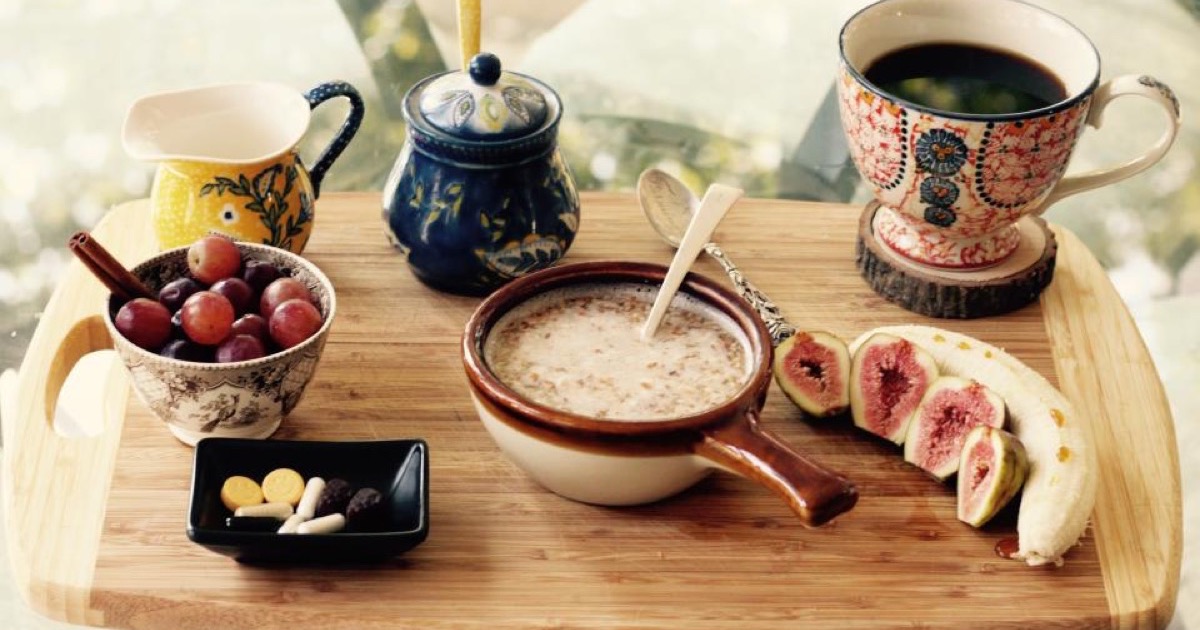
Cover photo: Breakfast Grapes by Mario Anthony Silvestri, CC0, via stocksnap.
Frequently asked questions
Is a banana a good pre-workout snack?
Yes, for most people. A medium banana (about 118 g) gives roughly 105 kcal and 27 g of carbohydrate with very little fat, so it is easy to digest 30 to 60 minutes before training. Add a small katori of curd if your last meal was more than 4 hours ago.
Can I drink chai or black coffee before the gym?
Yes, if it suits your stomach. ICMR-NIN puts a 150 ml cup of tea at about 30–65 mg of caffeine and brewed coffee at 80–120 mg. Have it about an hour before training, keep the day under about 300 mg, and skip it in the evening if it affects your sleep.
Should I eat poha or idli before a morning workout?
Both work if you have about 1 to 2 hours. A plate of poha from 40 g dry flakes is roughly 185 kcal and 31 g carbs, and three idlis are about 145 kcal and 28 g carbs. If you only have 20 to 30 minutes, a banana or a couple of dates is easier on the stomach.
Is it bad to work out on an empty stomach?
Not for most healthy adults doing an hour or less. A 2014 trial found fasted and fed cardio gave similar fat loss when both groups ate the same calorie deficit. Eat first if you feel dizzy or weak, if your session runs longer than an hour, or if you have diabetes and take insulin or sulfonylureas.
How many calories should a pre-workout meal have?
There is no fixed number. As a rough guide, a full meal 2–3 hours before might be 300 to 500 kcal and a snack 30 to 60 minutes before 100 to 200 kcal. Count it as part of your day's total, not as extra food.