
Gym First Aid Kit, AED and Emergency Plan: Owner's Checklist
A gym first aid and emergency plan for Indian owners: PAR-Q+ screening, why an AED matters, a first aid kit list, staff roles, 108/112 calls and an incident log.
A gym emergency plan has four parts: screen new members before they train hard, keep a stocked first aid kit and ideally an AED near the floor, train every shift to start CPR and use the AED, and write down who calls 112 or 108, who meets the ambulance and who logs the incident. Practise it every few months. In cardiac arrest, the minutes before the ambulance arrives are the ones your staff control.
This is general guidance for owners, not medical or legal advice. Rules vary by state, so check local requirements and talk to a lawyer about liability.
Why do emergencies happen in gyms?
The big one is sudden cardiac arrest. The AHA and ACSM scientific statement on exercise and acute cardiovascular events says that while regular exercise lowers heart disease risk overall, vigorous activity can briefly raise the risk of sudden cardiac death and heart attack in susceptible people. Events usually happen in people with existing structural heart disease, and they are most common in the least active people doing exercise they are not used to. In other words: the new member pushing hard in week one.
The other common ones:
- Heat illness. A crowded floor in May with weak ventilation is a real risk. The NHS lists the signs of heat exhaustion as dizziness, headache, nausea, heavy sweating, cramps and intense thirst.
- Fainting and dizziness, for example after training on an empty stomach or dehydrated.
- Low blood sugar in members with diabetes, which the NHS describes as shaking, sweating, hunger and confusion.
- Injuries: dropped plates, cuts from damaged equipment, sprains, a fall off a treadmill. Good upkeep prevents many of these, see our gym equipment maintenance schedule.
How should you screen members before they start?
The simplest tool is the PAR-Q+, a free questionnaire on the official PAR-Q+ and ePARmed-X+ site. It starts with seven yes/no questions. Anyone who answers yes goes on to follow-up questions, and may be advised to complete the ePARmed-X+ or speak to a qualified exercise professional or doctor.
ACSM also updated its preparticipation screening approach in 2015. It now looks at three things: how active the person already is, whether they have signs or symptoms of (or known) cardiovascular, metabolic or kidney disease, and how hard they want to train.
Keep the signed form with the membership file.
What is an AED and why do minutes matter?
An AED (automated external defibrillator) is a portable machine that reads the heart rhythm through two sticky pads on the chest and, if the rhythm is shockable, tells the user to press the shock button. Voice prompts guide each step.
Time is everything. A study of 1,667 out-of-hospital cardiac arrests in King County, USA (Larsen et al., 1993) found survival fell about 5.5 percentage points for every minute with no CPR, no shock and no advanced care. Starting CPR and shocking earlier both slowed that fall. The European Resuscitation Council's guidance, summarised in this BJA Education review, says bystander CPR increases survival rates by 2 to 3 times.
If the ambulance takes fifteen minutes in 7 pm traffic, your staff are the only treatment that person gets for those fifteen minutes.
That is why the 2002 AHA/ACSM statement on AEDs in health and fitness facilities encourages AEDs in gyms, and strongly encourages them in large facilities, in facilities running programmes for older or clinical members, and wherever the ambulance is expected to take more than five minutes to deliver a first shock. In most Indian cities, that last condition applies.
Where should the AED go, and how do you maintain it?
Placement:
- On the main floor or at the front desk, visible, with a sign. Not locked in the owner's cabin.
- Reachable from the cardio and free-weights areas in well under a minute.
Maintenance. AEDs run self-tests, but the pads and battery have expiry dates. Manufacturer manuals, like this AED user manual filed with the US FDA, tell owners to check the status indicator, check pad and battery expiry, and replace pads after every use. Put the AED on the same check sheet as your equipment: a quick look at the status light daily, a physical check monthly, and expiry dates written on a tag on the cabinet.
How do you train staff in CPR and AED use?
Every shift needs at least one trained person, ideally two. Front desk staff count, not just trainers.
India has its own resuscitation guidelines. The Indian Society of Anaesthesiologists set up the Indian Resuscitation Council, which published national CPR guidelines in the Indian Journal of Anaesthesia in 2017. There are separate protocols for laypeople and medics:
- Compression-only life support (COLS) for laypeople: recognise cardiac arrest, call for help, push hard and fast in the centre of the chest at about 120 per minute, at least 5 cm and no more than 6 cm deep.
- Basic Cardiopulmonary Life Support (BCLS) for trained medics and paramedics, which includes early defibrillation.
Certified COLS and BCLS courses are run through Comprehensive Resuscitation Training Centres at medical colleges and hospitals, such as this centre at HIMSR, New Delhi. Plan refreshers, because CPR skills fade without practice. For how this fits into roles and shift handovers, see managing gym staff.
What should be in a gym first aid kit?
Base your kit on a published list, then add what your risks need. The UK Health and Safety Executive's minimum list for low-risk workplaces is a sensible starting point. HSE also notes there are no tablets or medicines in it, and that sterile items carry expiry dates.
| Item | From the HSE minimum list? | Why a gym needs it |
|---|---|---|
| First aid guidance leaflet | Yes | Reminder for whoever opens the box |
| Sterile plasters, assorted sizes | Yes | Blisters, small cuts from knurling and plates |
| Sterile eye pads | Yes | Eye injuries |
| Triangular bandages | Yes | Arm slings, holding dressings |
| Safety pins | Yes | Fixing bandages |
| Large and medium sterile wound dressings | Yes | Bigger cuts, bleeding |
| Disposable gloves | Yes | Protects staff and member |
| Instant cold packs | Gym addition | Sprains, and cooling for heat illness (NHS suggests cold packs on armpits and neck) |
| ORS sachets and drinking water | Gym addition | Heat exhaustion: the NHS advises fluids and rehydration drinks |
| Glucose tablets or a sugary drink | Gym addition | Conscious member with a suspected hypo (NHS) |
| CPR face shield | Gym addition | For trained staff giving rescue breaths |
| Scissors, notepad and pen | Gym addition | Cutting clothing, noting times for the ambulance crew |
Check the box monthly, refill after every use, and note expiry dates on the lid.
What does the emergency action plan look like?
One laminated page near the AED and the desk. Assign roles by position, not name, so it works on every shift.
- Responder (first trained staff member on scene): checks if the person responds and is breathing normally. If not, shouts for help and starts chest compressions.
- Caller (front desk): calls 112 or 108 and reads out the address card. 112 is India's national emergency number for police, fire and ambulance, operational in all 36 States and UTs. The COLS guideline names 108 as the ambulance number. Keep your nearest hospital's emergency line on the card too.
- AED runner: brings the AED and the first aid kit, switches the AED on and follows the prompts while the responder keeps compressing.
- Guide: goes down to the gate or lift to meet the ambulance, holds the lift, and clears the path.
- Crowd and records: moves other members away, gives the person privacy, notes the time of collapse, of the call and of each shock.
The address card at the desk should have the full address, a landmark, the floor, which lift or staircase to use, the gym's phone number, and the nearest hospital with an emergency department.
Clear path: keep the route from the floor to the street free of stacked plates and boxes, wide enough for a stretcher.
The AHA/ACSM AED statement also recommends that facilities coordinate with local emergency services and run drills at least every three months, or more often when staff change.
How should you handle heat and dehydration?
Heat exhaustion first aid from the NHS: move the person somewhere cool, remove excess clothing, give water or a rehydration drink, and cool the skin with water or cold packs. They should improve within 30 minutes. If they don't, or if they have hot skin without sweating, confusion, a seizure or collapse, treat it as heatstroke and call 112 or 108.
Prevention is cheaper: working fans or AC, water on the floor, trainers watching beginners. Our guide on how much water to drink at the gym covers what to tell members, and the water intake calculator gives them a daily figure.
What should an incident log record?
Log every incident the same day. It shows patterns (the same bench keeps causing cuts) and gives you a factual record if anything is questioned later.
| Field | Example entry (hypothetical) |
|---|---|
| Date and time | 12 May, 7:40 pm |
| Member name and ID | Member ID 0412 |
| What happened | Felt dizzy after treadmill session, sat down |
| Where | Cardio area, treadmill 3 |
| First aid given | Moved to cool area, water given, recovered in 15 minutes |
| Emergency services called? | No |
| Staff on duty | Front desk, trainer on shift |
| Follow-up | Called member next day; advised to see a doctor before resuming hard cardio |
What about insurance, liability and good samaritan protection?
Talk to your insurer about public liability cover, and make sure your membership agreement asks members to declare health conditions. Waivers have limits in India, which we cover in our gym membership agreement guide.
On good samaritan protection: in SaveLIFE Foundation v. Union of India (2016), the Supreme Court approved guidelines to protect people who help accident victims. The Motor Vehicles (Amendment) Act, 2019 then added section 134A, which protects good samaritans from civil and criminal liability for injury or death caused by their negligence while helping a victim at the scene of an accident. As written, both are about road accidents involving a motor vehicle. They don't expressly cover a member collapsing on your gym floor, and your staff are on duty rather than passers-by. Ask your lawyer how liability works for your setup.
Quick checklist
- PAR-Q+ (or equivalent) signed by every new member; trainers know who answered yes.
- AED on the floor or at the desk, signed, never locked away, status light checked daily.
- Pad and battery expiry dates on a tag; pads replaced after every use.
- At least one CPR and AED trained person on every shift; refreshers booked.
- First aid kit based on the HSE list plus cold packs, ORS and glucose; checked monthly.
- One-page plan with roles: responder, caller, AED runner, guide, records.
- Address card with 112, 108 and the nearest hospital at the desk.
- Stretcher route kept clear; lift can be held.
- Drill at least every three months, and when new staff join.
- Incident log filled the same day, reviewed monthly.
Useful links
- Exercise and acute cardiovascular events, AHA/ACSM scientific statement (2007)
- AEDs in health/fitness facilities, AHA/ACSM (2002)
- PAR-Q+ and ePARmed-X+, official site
- Updating ACSM's preparticipation health screening recommendations (2015)
- Larsen et al., predicting survival from out-of-hospital cardiac arrest (1993)
- Changes to the ERC guidelines for adult resuscitation, BJA Education
- Compression-only life support (COLS), Indian Resuscitation Council guideline
- Basic Cardiopulmonary Life Support (BCLS), Indian Resuscitation Council guideline
- HSE: what to put in a first aid kit
- NHS: heat exhaustion and heatstroke
- NHS: low blood sugar (hypoglycaemia)
- PIB: ERSS 112 operational in 36 States/UTs (Nov 2025)
- PRS India: Motor Vehicles (Amendment) Bill, 2019
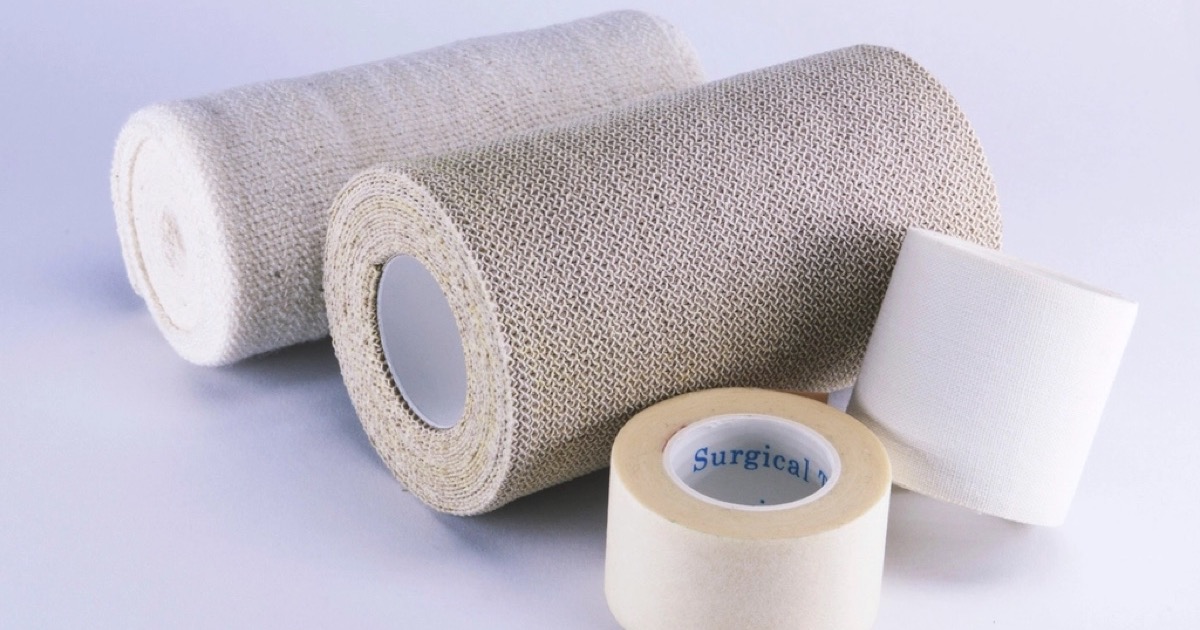
Cover photo: Bandages by an unknown photographer, CC0, via rawpixel.
Frequently asked questions
Is an AED legally required in a gym in India?
As of 2026 there does not appear to be a national rule making AEDs mandatory for Indian gyms, so check your state and local rules. The American Heart Association and American College of Sports Medicine encourage fitness facilities to have one, because the time from collapse to the first shock decides survival in cardiac arrest.
Can an untrained person use an AED?
AEDs are designed for bystanders: once switched on, the machine gives voice prompts, analyses the heart rhythm and only allows a shock when one is advised. Training still makes people faster and more confident, so train every staff member on each shift.
Which number should gym staff call in an emergency in India?
112 is the national emergency number for police, fire and ambulance, and it is operational in all 36 States and UTs. 108 is the ambulance number in most states. Put both on the desk card, along with your nearest hospital's own emergency number.
Should a gym keep painkillers or other medicines in the first aid kit?
No. Standard workplace first aid kits, such as the UK HSE minimum list, contain no tablets or medicines. Staff should not hand out medicines; members who need their own (an inhaler, insulin) should carry them.
How often should a gym run an emergency drill?
The AHA/ACSM statement on AEDs in fitness facilities recommends practising drills at least once every three months, and more often when staff change. A ten-minute drill at shift handover is enough.