
Gym Equipment Maintenance Schedule: Daily to Yearly Checks
A gym equipment maintenance schedule for Indian gyms: daily to yearly checks for treadmills, cable machines and racks, earthing, AMC questions and a log sheet.
A good gym equipment maintenance schedule has five layers: a daily walk-round by floor staff (cables, pins, upholstery, emergency stops), weekly checks of bolts, belt tracking and cable tension, monthly cleaning inside motor housings and guide rods, quarterly technician visits, and a yearly deep service and electrical check. The intervals for each machine come from its owner's manual, not from a generic list. Anything that fails a check gets an "out of order" tag the same minute, and every check goes in a log.
Why does preventive maintenance matter for a gym?
Downtime. Lose one of four treadmills in the 6 to 9 pm rush and you have a queue. Members don't complain about "maintenance". They complain about waiting. Small faults (a slipping belt, a loose console) usually come before big ones, and catching them early is cheaper.
Injuries. A frayed cable can snap under load. A loose J-hook can drop a bar. A treadmill whose stop key doesn't work is dangerous in a fall. The Life Fitness Cable Motion manual says plainly that cables "pose an extreme liability if used when frayed" and should be replaced at the first sign of wear.
Liability. Under Section 2(11) of the Consumer Protection Act, 2019, "deficiency" in a service includes any act of negligence or omission that causes loss or injury to the consumer. Your maintenance log is your evidence of reasonable care. For specifics, speak to a lawyer.
Why is the manufacturer's manual the source of truth?
Because similar-looking machines are maintained differently. Two public manuals show it:
- The Spirit Fitness CT900 treadmill manual describes a hard-waxed deck and says, "Do not apply any type of lubricant or wax to the surface." It asks for a monthly wipe under the belt edges instead.
- The Life Fitness T9e treadmill operation manual has a weekly to annual preventive maintenance schedule, asks you to check the emergency stop and stop magnet weekly, and says the belt should run 38 to 51 mm from either side of the frame.
A generic "lube the belt monthly" rule would damage the first machine. Keep every manual in one folder, paper plus a scanned copy. Lost one? Ask the dealer, quoting the model and serial number.
The master maintenance schedule
A starting point. Replace any interval with your manual's where they differ.
| Equipment | Daily | Weekly | Monthly | Quarterly | Yearly |
|---|---|---|---|---|---|
| Treadmills | Wipe rails and console; test stop key; listen for noise | Check belt centring and slip; test emergency stop; vacuum around and under | Clean under belt edges; vacuum motor compartment (power off, unplugged); check levelling | Technician: belt and deck wear, drive belt, rollers, lubrication only if manual says so | Full service; check plug, cord and socket earthing; review repair history |
| Ellipticals and bikes | Wipe handles, seat, pedals | Check pedals, straps, seat post lock, wobble | Tighten crank and handle bolts; clean covers | Technician: drive belt or chain, bearings, linkages | Full service per manual |
| Cable machines (selectorised) | Visual check of cables along full length; check pin and clips | Hardware tight; cable stretch and tension; grips; carabiners | Clean guide rods; tighten bolts | Technician: pulleys, bearings, cable ends | Replace worn cables; touch up paint; wax frames |
| Plate-loaded machines | Wipe upholstery; check pins and stops | Bolts, pivot points, adjustment pop-pins | Lubricate pivots per manual | Inspect welds and bearings | Full inspection |
| Free weights and benches | Rerack, wipe, check for torn upholstery | Bench bolts, backrest pins, dumbbell heads for looseness | Check plate and dumbbell condition; collars | Replace worn collars and pads | Reupholster as needed |
| Racks and platforms | Check J-hooks and safety arms seat fully | Anchor bolts, upright bolts, pin condition | Check J-hook liners and welds | Re-torque anchors | Full structural check |
| Flooring | Look for lifted edges, gaps, wet patches | Check under heavy-lift areas for tears | Check joins and drainage near washrooms | Replace damaged tiles | Review whole floor |
Where the cable machine intervals come from
The Life Fitness Cable Motion manual sets out a daily, weekly and monthly routine: daily cable checks along the whole length, weekly checks of hardware, clips and cable stretch, monthly guide-rod cleaning and bolt tightening. It also says to use only the maker's selector pins and to secure all equipment to a solid, level surface.
How should you maintain treadmills?
- Belt tension. The Spirit manual says to tighten only enough to stop slipping, a quarter turn at a time on both bolts evenly, and warns that over-tightening damages the belt and bearings. If it still slips, the drive belt under the motor cover may be the problem, which is a technician job.
- Tracking. Adjust in quarter turns at low speed and wait a few minutes between adjustments. Belt drift is normal; a belt rubbing the frame is not.
- Lubrication. Per the manual only. The Spirit CT900 must never be lubricated. If your manual names a lubricant and an interval, use exactly that product and that interval.
- Dust and the motor compartment. Unplug before opening any cover. Dust, lint and sweat build up near the motor and electronics; the T9e schedule includes vacuum-cleaning the motor compartment.
- Clearances. The Spirit manual cites ASTM F2115 minimums of 0.5 m on each side and 1 m behind, while the Life Fitness T9e asks for 2 m behind. Use the larger figure your manual gives.
What about electrical safety and stabilisers for treadmills in India?
Many manuals are written for 110 to 120 V American supply, so work through this with a licensed electrician.
Earthing comes first. Both manuals say the treadmill must be grounded and the plug must not be modified. In India, the CEA (Measures relating to Safety and Electric Supply) Regulations, 2023 require plug sockets in new or renovated installations up to 250 V to be three-pin, with the third pin permanently and effectively earthed (Regulation 43). Have the earth tested, not just assumed.
Dedicated circuits. Manuals disagree. Spirit's CT900 wants a dedicated circuit. The Life Fitness T9e accepts a non-dedicated line but, in its troubleshooting table, suggests a dedicated circuit when power is insufficient. Their amp ratings are for American versions, so use your own model's rating. On a commercial floor, separate circuits stop one tripping machine taking the others down.
RCDs (RCCBs). Regulation 44 of the same CEA rules requires installations to be controlled by a residual current device. Spirit's manual warns that ground-fault breakers can trip often with large motors. Don't remove or bypass the RCD. Ask your electrician for a layout where a nuisance trip affects one machine, with devices suited to motor loads.
Voltage and stabilisers. Spirit's manual says that if voltage varies by 10% or more, performance may suffer and such conditions aren't covered under warranty. If your supply is unstable, ask the dealer what stabiliser type and VA rating the maker approves, and get it in writing for warranty purposes. A stabiliser protects against voltage swings. It does not replace earthing or an RCD.
No extension boards. Spirit's manual advises against extension cords.
Which safety standards apply to gym equipment?
These are design and testing standards for manufacturers, useful when buying.
- ISO 20957 series. ISO 20957-1:2024 sets general safety requirements and test methods for indoor stationary training equipment, with classes for club and studio use (S and I) and home use (H). ISO 20957-6:2021 adds requirements specific to treadmills. In Europe they're published as EN ISO 20957.
- India. BIS has adopted these as IS 17801 (Part 1):2022 (general) and IS 17801 (Part 3):2022 (treadmills).
- ASTM F2115. The US standard specification for treadmills covers design and manufacture, including stability, guards, stop mechanisms and warnings, for users aged 13 and above.
Ask the seller which standard and class a machine is tested to; home-class equipment on a commercial floor wears out fast. Our gym equipment list for India covers what to buy first.
How should the "out of order" process work?
- Whoever finds the fault stops the machine and, for a treadmill, unplugs it.
- Hang a printed tag on it: "Out of order. Do not use." with the date, the fault and who found it. Remove the stop key or selector pin so nobody uses it anyway.
- Write it in the log and send a WhatsApp to the manager.
- The manager decides: in-house fix, AMC call, or part order.
- Only the manager removes the tag, after testing the machine, and signs the log.
The T9e manual says to keep equipment out of use until defective parts are repaired or replaced. The tag makes that happen.
A log sheet template
One sheet per machine, on paper or a spreadsheet.
| Date | Machine / ID | Check type | Finding | Action taken | Tagged out? | Done by | Manager sign |
|---|---|---|---|---|---|---|---|
| 07-10-2026 | Treadmill 2 | Weekly | Belt drifting left | Tracking adjusted, quarter turn | No | Floor trainer | Yes |
| 07-10-2026 | Lat pulldown | Daily | Cable fraying near pulley | Tagged, AMC called | Yes | Floor trainer | Yes |
Front page of each machine's log: model, serial number, purchase date, warranty end date, dealer contact and AMC details.
What should you ask for in an AMC?
Life Fitness, for example, describes preventive maintenance visits every 3 or 6 months depending on the contract, with a written checklist for each machine type. Use that as a benchmark. Ask any AMC provider:
- How many preventive visits a year, and which machines are covered?
- Is there a written checklist per machine type, and do I get a signed report each visit?
- What is the response time for a breakdown call?
- Are parts included, or only labour? Which consumables (belts, cables, grips) are excluded?
- Do you use genuine parts, and does your work keep the manufacturer's warranty valid?
Repair or replace?
Treat it as maths. A hypothetical: a new treadmill at ₹2,40,000 financed over 24 months at 12% a year costs about ₹11,300 a month in EMI, or roughly ₹1.36 lakh a year. If an old machine's repairs are heading towards that, replacement deserves a look. Check your own numbers with the gym equipment EMI calculator, and see what downtime does to your margins with the gym profit calculator. Budget for maintenance monthly, as our gym monthly expenses guide explains.
Who on your staff does what?
- Floor trainers: daily walk-round at opening, cable and pin checks, tagging faults, the weekly checklist for their zone.
- Housekeeping: the gym cleaning checklist, with cleaners the manuals allow; report torn upholstery.
- Manager: signs logs, calls the AMC, approves repairs, removes tags after testing, reviews the log monthly.
- Owner: AMC contract, yearly electrical check, repair-or-replace decisions.
Put these on each role card (see gym staff management).
The short version
- Every machine's manual in one folder, intervals copied into your schedule
- Daily walk-round: cables, pins, J-hooks, stop keys, upholstery, floor
- Weekly: bolts, belt tracking, cable tension, emergency stops
- Monthly: guide rods, under-belt cleaning, motor compartment (unplugged)
- Quarterly technician visit; yearly full service and electrical check
- Earthed three-pin sockets, RCD in place, no extension boards
- Out-of-order tags printed and ready; only the manager removes them
- One log per machine, signed
- AMC terms in writing
Useful links
- Life Fitness Cable Motion owner's manual (maintenance procedures)
- Life Fitness T9e treadmill operation manual
- Spirit Fitness CT900 treadmill owner's manual
- Life Fitness: preventive maintenance and service agreements
- CEA (Measures relating to Safety and Electric Supply) Regulations, 2023
- Consumer Protection Act, 2019 (Gazette)
- ISO 20957-6:2021, treadmills
- BIS: IS 17801 (Part 1):2022
- ASTM F2115-25, standard specification for treadmills
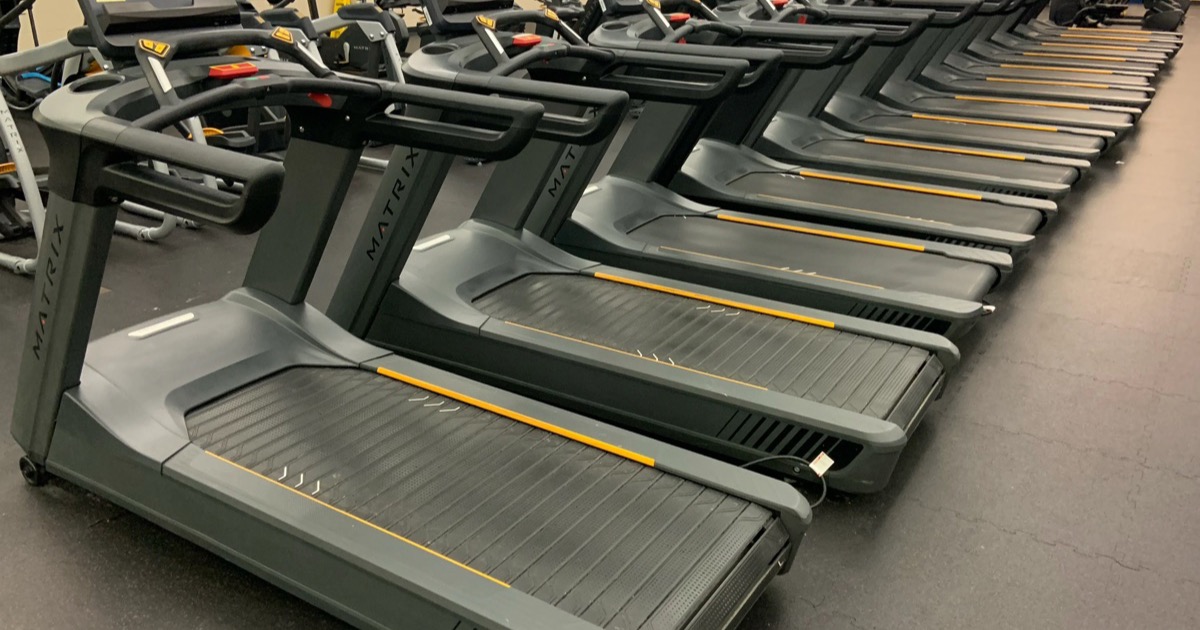
Cover photo: Treadmills by Wikideas1, CC0, via wikimedia.
Frequently asked questions
How often should a gym treadmill be serviced?
Follow the owner's manual for your model. As an example, one commercial treadmill manual asks owners to test the emergency stop weekly and vacuum the motor compartment on a set schedule, and Life Fitness sells preventive maintenance visits every 3 or 6 months. Busy gyms usually need a technician at least every quarter.
Should I lubricate my treadmill belt?
Only if your manual says so, with the product and interval it names. Some treadmills use a waxed deck where the manufacturer says not to apply any lubricant or wax at all, so a generic monthly routine can damage the belt and deck.
How often should gym cables be replaced?
There is no fixed number of months. Inspect cables daily and replace a cable at the first sign of fraying, bulging, kinks or flattened sections, which is what Life Fitness tells owners of its cable machines. Use only the maker's replacement cables and pins.
Do I need a stabiliser for a gym treadmill in India?
Check your manual and ask a licensed electrician to measure your supply. Manufacturers warn that large voltage swings hurt performance and may not be covered by warranty, so a correctly rated stabiliser is common where voltage is unstable. It does not replace proper earthing or an RCD.
What should a gym equipment AMC include?
The number of preventive visits a year, a written checklist per machine type, a response time for breakdowns, whether parts and labour are included, use of genuine parts, and a signed service report after every visit. Get all of it in writing before you pay.