
Home Workout Without Equipment: A 4-Week Plan for Small Spaces
A home workout with no equipment that builds real strength: a 4-week bodyweight plan, quiet no-jump options for flats, a 15-minute circuit and how to progress.
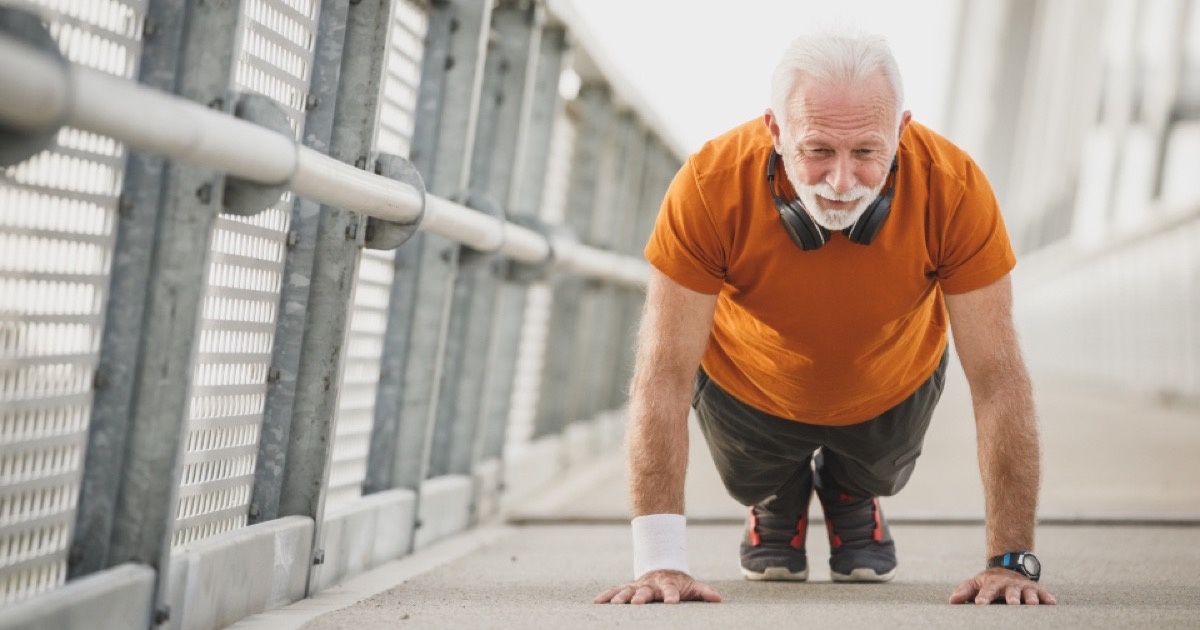
Yes, you can get stronger and build muscle at home with no equipment. Research shows that lighter loads, including your own bodyweight, build muscle about as well as heavy weights when you take your sets close to failure. Do three full-body sessions a week on non-consecutive days, make the moves a little harder every week, and you'll see real progress in a small room.
Below is a 4-week plan for a small room, with quiet versions for flats and a 15-minute busy-day circuit.
Can bodyweight training really build strength and muscle?
It can, with one condition: the sets have to be hard.
A 2017 meta-analysis by Schoenfeld and colleagues pooled 21 studies comparing low loads (60% of your one-rep max or less) with high loads, with every set taken to failure. Muscle growth was similar between the two. Heavy loads did win for one-rep max strength.
Push-ups are the best-studied home move. In a 2018 trial by Kotarsky and colleagues, 23 young men did either progressive push-up variations or bench press, 3 days a week for 4 weeks. Both groups improved their bench press one-rep max. Muscle thickness didn't change significantly in either group over such a short trial, so expect strength first and size later. A 2015 study by Calatayud and colleagues also found banded push-ups and bench press gave similar strength gains when effort was matched.
The 2026 ACSM position stand on resistance training, which pooled 137 systematic reviews, also found that equipment type did not consistently change results. What mattered more for muscle size was volume: about 10 or more hard sets per muscle a week. For the detail on sets and reps, see how many sets and reps build muscle.
The honest limit: once you can do 25 or 30 easy reps of something, reaching failure takes forever. That's your cue to move to a harder version.
How much exercise do you actually need each week?
The WHO 2020 guidelines say adults should do:
- 150 to 300 minutes of moderate aerobic activity a week, or 75 to 150 minutes of vigorous activity, or a mix
- Muscle-strengthening activity on 2 or more days a week, covering all major muscle groups
- Adults 65 and over: varied activity that focuses on balance and strength on 3 or more days a week, to help prevent falls
So this plan covers the strength part. For the aerobic part, walking counts. A brisk 30-minute walk on five days gets you to 150 minutes. If you want a daily target, steps per day for weight loss has the numbers.
What should a home warm-up include?
Five minutes is enough, about 30 to 45 seconds each:
- March on the spot, arms swinging
- Arm circles and hip circles
- Slow half squats
- Cat-cow on hands and knees
- Lunges on the spot, holding a door frame if needed
- Wall push-ups, 8 to 10 easy reps
What is the 4-week home workout plan?
Train 3 days a week with a rest day between, for example Monday, Wednesday and Friday. If you want a fourth day, add Saturday as a 15-minute circuit (below). For how much recovery you need, see how many rest days you need.
Each session uses the same 8 exercises, with 60 to 90 seconds' rest between sets. "RIR" means reps in reserve, the reps you could still have done.
| Exercise | Week 1 | Week 2 | Week 3 | Week 4 |
|---|---|---|---|---|
| Squat | 2 × 10 to 12 | 3 × 10 to 12 | 3 × 12 to 15 | 3 × 12 to 15, 3-second lowering |
| Reverse lunge (each leg) | 2 × 8 | 2 × 10 | 3 × 10 | 3 × 12 |
| Push-up (your level) | 2 × 3 RIR | 3 × 3 RIR | 3 × 2 RIR | 3 × 1 to 2 RIR |
| Glute bridge | 2 × 12 | 3 × 12 | 3 × 15 | 3 × 10 single-leg each side, or 3 × 20 |
| Step-up on a stair (each leg) | 2 × 8 | 2 × 10 | 3 × 10 | 3 × 12 |
| Chair dip | 2 × 6 to 8 | 2 × 8 to 10 | 3 × 8 to 10 | 3 × 10 to 12 |
| Superman (back raise) | 2 × 8, 2-second hold | 2 × 10 | 3 × 10 | 3 × 12, 3-second hold |
| Plank | 2 × 20 s | 3 × 25 s | 3 × 30 s | 3 × 40 s |
A session takes 30 to 40 minutes including the warm-up.
Burpees are optional: if noise isn't an issue, add 2 sets of 6 to 10 in weeks 3 and 4.
Moving to a gym later? The beginner gym workout plan picks up from here.
How do you make each exercise easier or harder?
Start at the level where you can do about 8 clean reps. When you hit the top of the rep range with 1 to 2 reps to spare, move one step right.
| Exercise | Easier | Standard | Harder |
|---|---|---|---|
| Push-up | Wall push-up, then kitchen counter push-up | Knee push-up, then full push-up | Feet on a chair, then slow 3-second lowering |
| Squat | Sit-to-stand from a chair | Bodyweight squat | Split squat, then rear foot on a chair (Bulgarian split squat) |
| Lunge | Static split squat holding a wall | Reverse lunge | Walking lunge, then lunge with a backpack |
| Glute bridge | Bridge with a short range | Full glute bridge | Single-leg bridge, then shoulders on the sofa (hip thrust) |
| Chair dip | Knees bent, short range | Knees bent, full range | Legs straight, then feet on a second chair |
| Step-up | Lowest stair, hand on railing | One stair, no hands | Higher step, or holding water bottles |
| Plank | On knees, or hands on a table | Forearm plank | Plank with alternate arm reach |
| Superman | Lift arms only, or legs only | Arms and legs together | Longer hold, arms stretched fully overhead |
How can you use household items as weights?
A few practical swaps for dumbbells:
- Water bottles. A full 1-litre bottle weighs about 1 kg, a 2-litre about 2 kg. Good for step-ups, lunges and shoulder raises.
- A school backpack with books. Pack it with books or rice packets and weigh it on a kitchen or bathroom scale. Wear it zipped, straps tight, for squats, lunges and push-ups. Start with 3 to 5 kg.
- A sturdy chair or the sofa. For dips, incline push-ups, split squats and hip thrusts. Push a chair against a wall so it can't slide.
- The stairs. The lowest step of your building's staircase works for step-ups and calf raises.
What is a good 15-minute workout for busy days?
Set a timer for 40 seconds of work and 20 seconds of rest. Do these 5 moves back to back, rest 1 minute, and repeat for 3 rounds. That's 14 minutes.
- Squat (or squat with 3-second lowering)
- Push-up at your level
- Reverse lunge, alternating legs
- Glute bridge
- Plank
Work at a pace where talking is hard but possible. If you wear a fitness watch, the heart rate zone calculator shows what zone 3 to 4 looks like for your age.
Which exercises are quiet enough for a flat?
Anything without a jump or landing:
- Replace jumping jacks with fast marching on the spot or step-jacks (one foot out at a time)
- Replace jump squats with squats with a 3-second lowering and a 1-second pause at the bottom
- Replace burpees with "step-back burpees": hands down, step the feet back one at a time, step in, stand up
- Train on a folded mat or carpet
Slow reps aren't a compromise: a 3-second lowering makes each rep harder, so you reach failure sooner.
Where does surya namaskar fit in?
Surya namaskar works well as a warm-up, a light day or a cardio-style session, and needs only a mat.
The 2024 Adult Compendium of Physical Activities rates surya namaskar at 3.5 MET, a bit more than general bodyweight exercise at 3.0 MET and well below high-intensity bodyweight work at 6.5 MET. At 60 kg, 20 minutes of surya namaskar is about 3.5 × 60 × 0.33 = 70 kcal. Put in your own weight and time with the calories burned calculator.
It doesn't get much harder as you get stronger, so pair it with the plan above rather than replacing it.
Is this safe for beginners, older adults and pregnant women?
For most healthy adults, yes.
- Knees. Some knee bend over the toes is normal in a squat. Keep the knee in line with your second toe, not caving in. If a full squat hurts, use a chair and a shorter range. Sharp pain or swelling means stop and see a doctor or physiotherapist.
- Lower back. Don't let your hips sag in a plank or push-up. If you already have back pain that runs down a leg, get it checked first.
- Beginners. Start at the easier column. Stop sets 2 to 3 reps short of failure for the first two weeks.
- Older adults. WHO's advice for over-65s is balance and strength work on 3 or more days a week. Use the chair versions and add balance work, like standing on one leg holding the counter.
- Pregnancy. WHO advises at least 150 minutes of moderate activity a week for pregnant women without contraindications, including muscle strengthening. The NHS advises avoiding lying flat on your back for more than a few minutes in later pregnancy and stopping if you feel unwell or too hot. Check with your doctor or midwife before starting a new routine.
Also see a doctor first if you have heart disease, uncontrolled blood pressure, diabetes on medication, a recent injury or surgery, or chest pain or dizziness with exertion.
How do you keep progressing after 4 weeks?
Change one thing at a time:
- Add reps until you hit the top of the range
- Slow the tempo: 3 seconds down, 1-second pause
- Move to a harder variation from the table, and drop back to the bottom of the rep range
- Add load with a backpack or water bottles
- Add a set, up to about 4 per exercise
What should you track?
Note the date, exercise, variation, sets and reps in a notebook or phone. Measure your waist or weight once a week, not daily. If nothing has moved in two weeks, check sleep and food before blaming the plan.
The short version
- Train 3 days a week, full body, rest days in between
- Take sets close to failure: low loads build muscle when the effort is high
- Progress every week with reps, slower tempo, harder variations or a loaded backpack
- Add brisk walking to reach 150 to 300 minutes of activity a week
- Use slow, no-jump versions in a flat
- Older adults: chair versions plus balance work; pregnancy or medical conditions: check with your doctor first
This is general information, not medical advice.
Useful links
- Schoenfeld et al. (2017), strength and hypertrophy with low vs high load training
- Kotarsky et al. (2018), progressive calisthenic push-up training
- Calatayud et al. (2015), bench press and push-up at comparable muscle activity
- ACSM position stand (2026), resistance training prescription
- WHO 2020 guidelines on physical activity and sedentary behaviour
- 2024 Adult Compendium of Physical Activities: conditioning exercise
- NHS: exercise in pregnancy
Cover photo: Push Ups by Direct Media, CC0, via stocksnap.
Frequently asked questions
Can you build muscle with only bodyweight exercises?
Yes, especially as a beginner. A 2017 meta-analysis found lighter loads built muscle about as well as heavy loads when sets were taken to failure. The catch is that you must keep making the exercises harder, with more reps, slower reps or tougher variations, or progress stalls.
How many days a week should I work out at home?
Three full-body sessions a week on non-consecutive days is plenty for a beginner, and it covers WHO's advice of muscle-strengthening work on at least 2 days a week. Add brisk walking or other cardio on most days to reach 150 to 300 minutes of moderate activity a week.
Is a 15-minute home workout enough?
On a busy day, yes. Fifteen minutes of hard bodyweight work still counts towards your weekly strength and activity targets, and it keeps the habit going. Over a full week, though, you'll get better results from two or three longer sessions as well.
What is a good no-jump workout for a flat?
Swap jumps for slow, controlled moves: squats with a 3-second lowering, reverse lunges, step-ups on the lowest stair, glute bridges, push-ups, plank and fast marching on the spot instead of jumping jacks or burpees. Training on a folded mat or carpet softens any noise further.
How many calories does a home bodyweight workout burn?
The 2024 Compendium of Physical Activities rates general bodyweight exercise at 3.0 MET and high-intensity bodyweight work at 6.5 MET. For a 70 kg person, 30 minutes works out to roughly 105 kcal at an easy pace and about 228 kcal at a hard pace.