
Gym Interior Design on a Low Budget: Walls, Mirrors, Lighting
Gym interior design on a low budget: what to spend on (light, mirrors, one brand wall), what to skip, paint maths, lux levels, mirror height and safety glass.
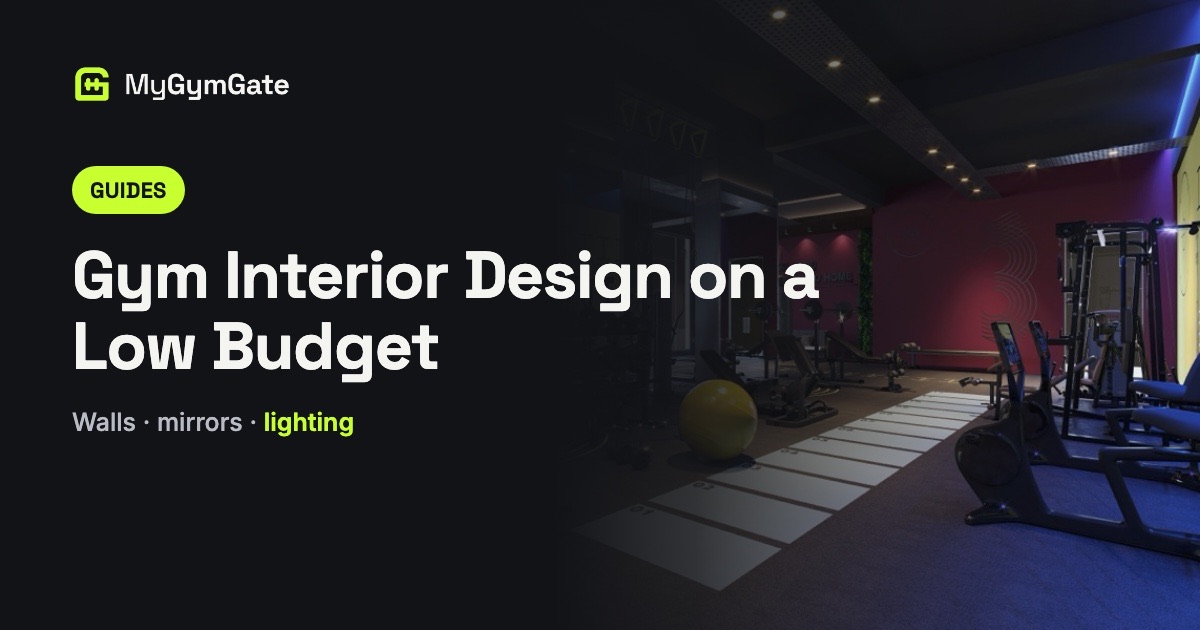
Gym interior design on a low budget comes down to spending on the few things members notice every visit, bright even lighting, well-placed mirrors and one strong brand wall, and keeping everything else plain, light-coloured and easy to clean. Aim for about 300 lux on the floor (the figure CIBSE's lighting guide gives for sports halls and gymnasiums), mirrors at least 20 inches off the floor in safety glass, white or near-white ceilings and walls that bounce light, and colour used to mark zones rather than to cover every surface. Most of the "premium" look comes from light and order, not cladding.
This guide is about the finish. For where the racks and treadmills go, see how to lay out a small gym; for what goes on the floor, the gym flooring guide.
Where should a small budget go first?
| Item | Why it matters | Budget approach |
|---|---|---|
| Lighting | Every photo, reel and first visit depends on it | Spend: LED panels or battens with diffusers, enough of them |
| Mirrors | Members use them every set | Spend: safety glass, right height, right walls |
| Paint | Biggest surface, cheapest change | Save: one good emulsion, light colours |
| Brand wall | What people photograph | Spend a little: one wall, not four |
| Flooring colour | Zones without walls | Use what you're buying anyway: colour bands, turf strip |
| Ceiling | Light and height | Save: exposed, painted white |
| Acoustics | Comfort in classes | Low cost: a few panels where it echoes |
| Decor, cladding, neon | Looks nice in a render | Skip until members and cash flow justify it |
Walls: paint, graphics and branding
Do the paint maths
Paint is cheap if you work it out first. A worked example for a hypothetical 1,500 sq ft gym (about 50 × 30 ft, 10 ft ceiling):
- Walls: perimeter (50 + 30) × 2 = 160 ft × 10 ft = 1,600 sq ft
- Less mirrors, windows and doors, say 400 sq ft: 1,200 sq ft
- Ceiling: 1,500 sq ft
- Total to paint: 2,700 sq ft
Asian Paints' page for its Tractor Emulsion lists 130 to 150 sq ft per litre for two coats on a normal masonry surface, with an MRP of ₹4,180 for 20 litres and ₹258 for 1 litre when we checked in October 2026. Using the lower coverage figure: 2,700 ÷ 130 = 20.8 litres, so one 20-litre bucket plus a litre: ₹4,180 + ₹258 = ₹4,438 in paint at MRP. Primer, putty, labour and any texture are extra, so get the painter's quote per sq ft and check it against this.
Whatever brand you use, take the coverage from its own label, and price the job as area ÷ coverage × price per litre.
Colours that work
- Ceiling and most walls: white or a very light neutral. Lighting guidance under EN 12464-1 gives recommended reflectance of 0.7 to 0.9 for ceilings, 0.5 to 0.8 for walls and 0.2 to 0.4 for floors in workrooms. A gym's black rubber floor sits at the bottom of that, so light walls and ceiling do the bouncing.
- One feature wall in your brand colour. Behind the reception or the free-weights area, where members take photos.
- Darker, scuff-hiding colour only at the bottom. A painted band up to about knee height near racks and benches hides plate marks.
Wall graphics and branding
A printed vinyl or painted mural on one wall gives more personality than paint on four. Keep it simple: logo, gym name, one line ("Show up. Every day."), maybe your city's skyline. Put the logo where a phone camera naturally points, often the mirror wall facing the racks, because members' selfies become your free marketing.
Use the same logo and colours everywhere members see you: the signboard, the wall, the joining form, WhatsApp messages and the TV screen. MyGymGate puts the gym's own logo and colours on the app, emails, QR pass and TV leaderboard, so the wall and the screens match.
Mirrors: placement and safety
Mirrors double as a design feature and a coaching tool, but they're also the biggest sheets of glass in the room.
- Height and gap. NSCA's facility guidelines put mirrors 20 inches from the floor and 6 inches from equipment. Keeping the bottom clear also keeps the glass away from where plates and dumbbells land.
- Which walls. Facing the dumbbell rack and benches, in front of the stretching area, and in the group studio. Not behind treadmills. The layout guide covers sightlines from the desk.
- Safety glass. BIS publishes a code of practice for glass safety related to human impact (IS 16231 Part 4: 2019). Ask your supplier in writing what glass and backing they're offering, whether it's toughened, laminated or safety-backed, and how it's fixed to the wall. If a mirror breaks, you want it to stay on the wall, not fall in sheets.
- Joints. Fewer, larger panels look better than many small ones, but each panel has to be handled and fixed safely. Let the installer decide panel size.
Lighting: how bright is bright enough?
The CIBSE SLL Lighting Guide 5 table reproduced by Thorlux lists sports halls and gymnasiums at 300 lux maintained horizontal illuminance, with a glare limit (UGR) of 22 and colour rendering (Ra) of 80. Treat 300 lux as the floor, not the target: free-weights and functional areas often look and feel better a little brighter, while the stretching corner can be softer.
The US military's lighting criteria, UFC 3-530-01, add practical points for gyms that apply to any budget:
- Use luminaires with lenses or louvers to minimise glare.
- Use wire guards or polycarbonate lenses where things can be thrown or swung into the light.
- Give each activity area its own switching zone.
- Light the room surfaces to balance brightness, and minimise shadows.
On a low budget that translates to:
- Diffused LED panels or battens over the floor, spaced evenly. No bare bulbs.
- Nothing glaring directly above a bench. People lie on their backs looking up; offset fittings to the side.
- Separate switches for cardio, weights, studio and reception, so the afternoon lull doesn't light an empty floor.
- A cheap lux meter to check the darkest corner after installation. Phone apps are only a rough guide.
- Warm-white for reception, neutral-white for the floor is an easy combination that works.
LED fittings also cut the bill; the electricity bill guide covers sensors and switch-off routines.
Ceiling: exposed or false?
For most small gyms, exposed and painted white wins: lowest cost, keeps the height members feel, and AC pipes, wiring and speakers stay easy to reach for repairs. Paint exposed pipes the same colour as the ceiling so they disappear.
A false ceiling earns its cost when you need it for something: hiding ducts for a ducted AC, carrying acoustic tiles in a group studio, or covering a damaged slab. Check ceiling height first; overhead presses and box jumps need clearance.
Colour and zoning without walls
Partitions eat space and money. Use the floor and a few signs instead:
- Rubber colour bands or a different tile colour for the free-weights zone.
- A turf strip for sled pushes and functional work.
- Floor markings for walkways and the treadmill run-off.
- Wall signs above each zone ("Free weights", "Cardio", "Stretch") in your brand font.
Sound: the cheap fixes
Bare walls, glass and a hard ceiling make a gym echo, so the music has to go louder for people to hear it, and trainers end up shouting. Fabric-wrapped acoustic panels absorb some of that echo; a few on the walls of the group studio and near the speakers are a low-cost start. Point speakers at the floor, away from shared walls.
Ventilation: don't design it out
Sealed windows and a nice ceiling don't help if the room is stuffy at 7 pm. Plan fresh air and AC capacity with the interiors, not after; our guide to AC tonnage and ventilation for gyms has the sums.
Quick checklist
- Lighting plan: about 300 lux minimum, diffused fittings, nothing glaring over benches, zoned switches
- Mirrors in safety glass or safety-backed, 20 inches off the floor, 6 inches from equipment
- Ceiling and most walls white or very light
- One brand wall where photos happen
- Paint quantity worked out from area and the label's coverage
- Scuff band near racks and benches
- Zones marked with flooring colour and signs, not partitions
- Acoustic panels in the studio
- Fresh air and AC planned before the ceiling goes up
Useful links
Frequently asked questions
How much paint does a 1,500 sq ft gym need?
Roughly 20 to 21 litres of emulsion for two coats on the walls and ceiling, if about 2,700 sq ft needs painting after mirrors and windows. One leading interior emulsion lists 130 to 150 sq ft per litre for two coats; use the lower figure so you don't run short, and add primer and putty.
What colour should a gym ceiling be?
Light, if you want to save on lights. EN 12464-1's recommended reflectance for ceilings is 0.7 to 0.9, which means white or near-white. A black ceiling looks dramatic but soaks up light, so you need more fittings to reach the same brightness on the floor.
Are normal mirrors safe for a gym?
Ask for safety glass or a safety-backed mirror. Gym mirrors sit near racks, dumbbells and moving people, and BIS has a code of practice for glass safety related to human impact (IS 16231 Part 4). Mount them at least 20 inches off the floor and keep equipment 6 inches away.
What should go on a gym's brand wall?
Keep it simple: your logo, the gym's name and one short line, in your brand colours, on one wall where members naturally take photos, such as the mirror wall facing the racks or behind reception. One strong wall does more than paint or graphics on all four.