
How to Load a Barbell: Plate Maths in kg (With Chart)
How to load a barbell in kg: bar weights, plate colours, the per-side formula, a plate chart from 30 to 200 kg on a 20 kg bar, collars, lb plates and safety.
To load a barbell, subtract the bar weight (and collars, if they are heavy) from your target, divide by two, and put that much on each side with the heaviest plates closest to the middle. On a standard 20 kg Olympic bar, 60 kg is one 20 kg plate per side, 100 kg is 25 + 15 per side, and 140 kg is 25 + 25 + 10 per side. Always use collars, load and unload both sides evenly, and put the plates back when you finish.
Below is the full plate chart from 30 to 200 kg, the competition colour code, and the practical bits nobody tells you on day one. If you'd rather not do the maths at all, the barbell plate calculator shows the plates per side for any target.
How much does the bar weigh?
This is where most beginner mistakes start. There isn't one "gym rod".
Under the IWF Technical and Competition Rules, a men's weightlifting bar weighs 20 kg and a women's bar weighs 15 kg. Powerlifting uses a 20 kg bar too: the IPF Technical Rules Book says the bar and collars together must weigh 25 kg, with each collar weighing 2.5 kg.
Most Indian gyms also have shorter straight bars with thin ends and EZ curl bars. These come from many local manufacturers and their weight varies, so don't guess. Put yours on the gym's weighing scale once and write the number down. Fixed-weight pre-loaded bars have the total printed on the end.
What do the plate colours mean?
Competition plates are colour coded so referees can read the bar from a distance. The IWF rules:
| Plate | IWF colour | Small plate | IWF colour |
|---|---|---|---|
| 25 kg | Red | 2.5 kg | Red |
| 20 kg | Blue | 2 kg | Blue |
| 15 kg | Yellow | 1.5 kg | Yellow |
| 10 kg | Green | 1 kg | Green |
| 5 kg | White | 0.5 kg | White |
The IPF code is shorter: 25 kg red, 20 kg blue, 15 kg yellow, and 10 kg and under can be any colour. IPF discs run from 1.25 kg to 25 kg, with lighter discs (down to 0.25 kg) allowed only for record attempts.
In a normal gym, don't trust colour. Plenty of plates are black or painted at random. Read the number on the plate, and check whether it says kg or lb.
What is the formula for plates per side?
Plates per side = (target weight − bar weight − collar weight) ÷ 2
If your gym uses the light spring clips, treat the collars as zero. If you're using heavy 2.5 kg competition-style collars, subtract 5 kg for the pair.
Two worked examples:
- 80 kg on a 20 kg bar, spring clips: (80 − 20) ÷ 2 = 30 kg per side, so one 25 and one 5 on each side.
- 100 kg on a 20 kg bar with 2.5 kg collars: (100 − 20 − 5) ÷ 2 = 37.5 kg per side, so 25 + 10 + 2.5 on each side.
To check a bar someone else loaded, run it backwards: add up one side, double it, add the bar. 25 + 20 on each side of a 20 kg bar is (45 × 2) + 20 = 110 kg.
Barbell plate chart: 30 to 200 kg on a 20 kg bar
This chart assumes a 20 kg bar, spring clips (counted as zero), and plates of 25, 20, 15, 10, 5, 2.5 and 1.25 kg. It uses the fewest plates possible, heaviest first. Weights are per side.
| Total (kg) | Per side (kg) | Plates on each side |
|---|---|---|
| 30 | 5 | 5 |
| 35 | 7.5 | 5+2.5 |
| 40 | 10 | 10 |
| 45 | 12.5 | 10+2.5 |
| 50 | 15 | 15 |
| 55 | 17.5 | 15+2.5 |
| 60 | 20 | 20 |
| 65 | 22.5 | 20+2.5 |
| 70 | 25 | 25 |
| 75 | 27.5 | 25+2.5 |
| 80 | 30 | 25+5 |
| 85 | 32.5 | 25+5+2.5 |
| 90 | 35 | 25+10 |
| 95 | 37.5 | 25+10+2.5 |
| 100 | 40 | 25+15 |
| 105 | 42.5 | 25+15+2.5 |
| 110 | 45 | 25+20 |
| 115 | 47.5 | 25+20+2.5 |
| 120 | 50 | 25+25 |
| 125 | 52.5 | 25+25+2.5 |
| 130 | 55 | 25+25+5 |
| 135 | 57.5 | 25+25+5+2.5 |
| 140 | 60 | 25+25+10 |
| 145 | 62.5 | 25+25+10+2.5 |
| 150 | 65 | 25+25+15 |
| 155 | 67.5 | 25+25+15+2.5 |
| 160 | 70 | 25+25+20 |
| 165 | 72.5 | 25+25+20+2.5 |
| 170 | 75 | 25+25+25 |
| 175 | 77.5 | 25+25+25+2.5 |
| 180 | 80 | 25+25+25+5 |
| 185 | 82.5 | 25+25+25+5+2.5 |
| 190 | 85 | 25+25+25+10 |
| 195 | 87.5 | 25+25+25+10+2.5 |
| 200 | 90 | 25+25+25+15 |
Missing a plate size? Swap in a combination with the same total. No 15s: use 10 + 5. No 25s: use 20 + 5. For a 15 kg bar or a different bar, put your numbers into the plate calculator.
In what order should you load the plates?
Heaviest on first, closest to the middle of the bar, then lighter plates in descending order towards the end. The IWF rules describe exactly this: discs are loaded with the heaviest first and the lighter ones in descending order towards the outer edge. The IPF says the same, with heavier discs innermost.
In a normal gym it helps too: the stack sits steadier, small plates on the outside are easy to change between sets, and anyone can read the bar at a glance.
Push each plate all the way in so there's no gap, then put the collar on tight against the last plate.
Why do collars matter?
Plates slide. When a bar tilts slightly, as it often does when you un-rack a squat or one arm locks out first on the bench, a loose plate can creep off the end. The other side is suddenly much heavier and the bar flips.
The IPF rules state collars "shall always be used" in competition. In the gym, the cheap spring clips do the job for most sessions. Use them every set, including warm-ups.
One exception lifters argue about: some people bench without collars when training alone so they can tip the plates off if they get stuck. A far better answer is to bench in a rack with safety arms set just below chest height, or with a spotter, and keep the collars on.
How do you unload a barbell without it tipping?
A loaded bar on J-hooks is balanced only because both sides weigh the same. Strip one side completely and the bar can tip off the rack.
Unload it like this:
- Remove both collars.
- Take the outer plate off one side.
- Walk round and take the matching plate off the other side.
- Repeat, one plate at a time, alternating sides.
If you're the only one unloading a heavy bar, never take off more than one plate's difference at a time. With a partner, you can each take one side and pull plates together. Load the same way: one plate on the left, one on the right, never a full side at once.
What is microloading, and when should you use it?
Microloading means very small jumps, like 1.25 kg per side (2.5 kg total) or less. Sooner or later a 5 kg jump on the bench or overhead press is too much, especially for lighter lifters. Options:
- 1.25 kg plates: 2.5 kg total jump. Ask at the front desk if you can't find them.
- Fractional plates (0.5 kg, 0.25 kg): IPF rules allow discs this small for record attempts. Some gyms have them; many lifters buy a cheap pair and keep them in their bag.
- Add reps instead of weight: if you can't make a small jump, stay at the same load and add a rep per set until the next jump feels manageable. The sets and reps guide covers rep ranges for building muscle.
How should you warm up to your working weight?
Don't load your top set straight away. A ramp lets you practise the movement and spot any aches before the weight gets heavy. Here's a hypothetical example for someone squatting 3 sets of 5 at 100 kg on a 20 kg bar:
| Set | Load | Plates per side | Reps |
|---|---|---|---|
| 1 | 20 kg | Empty bar | 8–10 |
| 2 | 40 kg | 10 | 5 |
| 3 | 60 kg | 20 | 3 |
| 4 | 80 kg | 25 + 5 | 2 |
| 5 | 90 kg | 25 + 10 | 1 |
| Working sets | 100 kg | 25 + 15 | 3 × 5 |
Each step changes only a plate or two. Not sure what your working weight should be? Estimate your max with the one-rep max calculator, then pick a percentage from the 1RM percentage chart.
How do you convert lb plates to kg?
Some gyms in India have imported or second-hand plates marked in pounds. The conversion is exact: NIST lists 1 avoirdupois pound as 0.453 592 37 kg.
| lb plate | kg (rounded) |
|---|---|
| 45 lb | 20.41 kg |
| 35 lb | 15.88 kg |
| 25 lb | 11.34 kg |
| 10 lb | 4.54 kg |
| 5 lb | 2.27 kg |
| 2.5 lb | 1.13 kg |
So a 20 kg bar with one 45 lb plate per side is 20 + (2 × 20.41) = about 60.8 kg, not 60. If you mix lb and kg plates, make sure both sides match.
Gym etiquette: put your plates back
Strip your bar when you're done, unload evenly, and return plates to the right peg on the tree, heavy ones low. Don't leave plates on the floor where someone will trip on them.
If you're following a push pull legs split or the beginner gym workout plan, you'll be sharing barbells at peak hours, so clear yours quickly.
What safety basics apply to barbell lifts?
The NSCA's professional standards say that, together with safety equipment such as power racks, attentive spotting must be provided when free weights are supported on the trunk or moved over the head or face. In plain terms, that means squats, bench press and overhead press.
- Squat in a rack with the safety arms (or pins) set just below the bottom of your squat. If you fail a rep, you sit down and let the bar rest on them.
- Bench in a rack with safety arms just below chest height, or ask someone to spot you. A spotter should stand behind your head, ready to help, not lift the bar for you.
- Check the load before you lift. Count both sides.
- Clear the floor around your bar of loose plates and clips.
- Stop a set when your form breaks, not when you physically can't move the bar.
If you have a heart condition, high blood pressure, a recent injury, are pregnant or are under 18, talk to a doctor or a qualified coach before starting heavy barbell training.
The short version
- Bar weights: men's Olympic bar 20 kg, women's 15 kg; weigh short straight and EZ bars yourself
- Per side = (target − bar − collars) ÷ 2
- Heaviest plates go on first, closest to the centre
- Read the number on the plate, not the colour, and check kg vs lb
- Collars on every set
- Load and unload one plate at a time, alternating sides
- Use 1.25 kg or smaller plates for small jumps on presses
- Warm up in steps; set safety arms before heavy sets
- Strip the bar and re-rack the plates when you're done
This is general information, not medical advice.
Useful links
- IWF Technical and Competition Rules & Regulations 2020 (hosted by the Indian Weightlifting Federation): bar weights, disc colours, collars and loading order
- IPF Technical Rules Book 2026: bar and collar weight, disc range and colours, loading order
- NIST Handbook 44, Appendix C: General Tables of Units of Measurement: exact pound-to-kilogram factor
- NSCA Strength and Conditioning Professional Standards and Guidelines: spotting and safety equipment
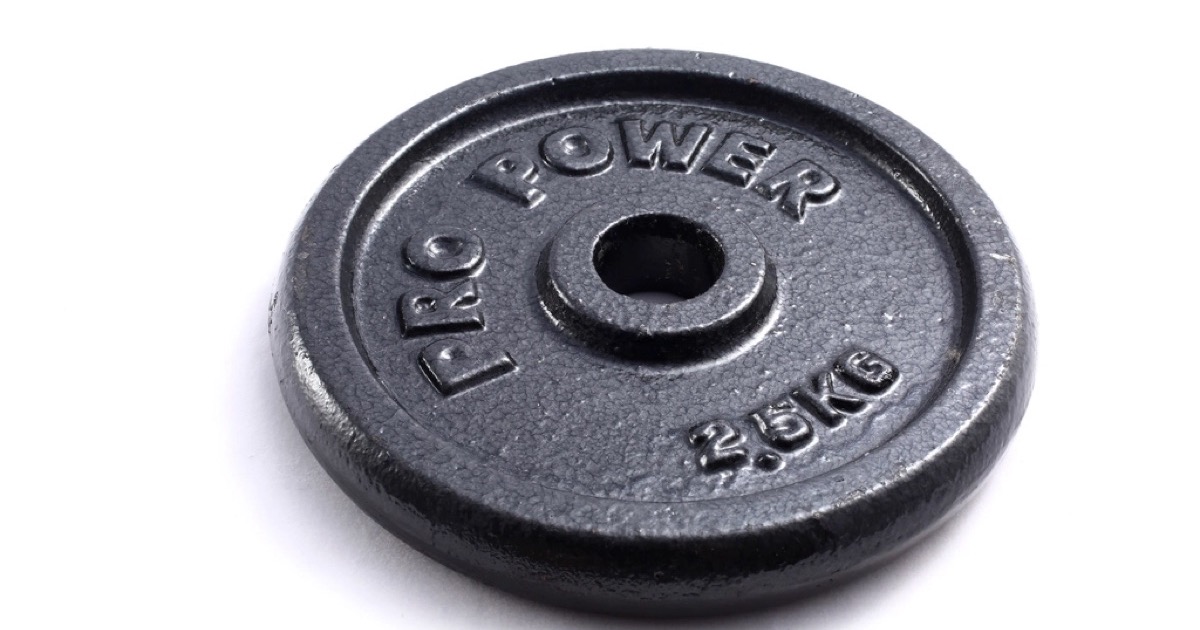
Cover photo: Free barbell weight plate image by an unknown photographer, CC0, via rawpixel.
Frequently asked questions
How much does the barbell in the gym weigh?
A men's Olympic bar weighs 20 kg and a women's Olympic bar weighs 15 kg under IWF rules. Many Indian gyms also have shorter straight bars and EZ curl bars that weigh much less and vary by brand, so weigh yours once on a scale rather than guessing.
How many plates do I need on each side for 100 kg?
On a 20 kg bar with light spring clips, you need 40 kg per side: one 25 kg plate and one 15 kg plate. If your gym has no 15 kg plates, use 25 + 10 + 5 on each side instead.
Does the bar count in the weight I lift?
Yes. The weight you log is the bar plus all the plates, plus the collars if they are heavy competition collars. A 20 kg bar with a 20 kg plate on each side is 60 kg, not 40 kg.
How do I convert a 45 lb plate to kg?
Multiply by 0.45359237, the exact factor NIST gives. A 45 lb plate is about 20.4 kg, so a 20 kg bar with one 45 lb plate per side is about 60.8 kg.
Should I put heavy or light plates on first?
Heaviest first, closest to the centre of the bar, then lighter plates in descending order towards the end. That is how IWF and IPF competitions load a bar, and it keeps the load stable and easy to read.